
Understanding what you’re dealing with
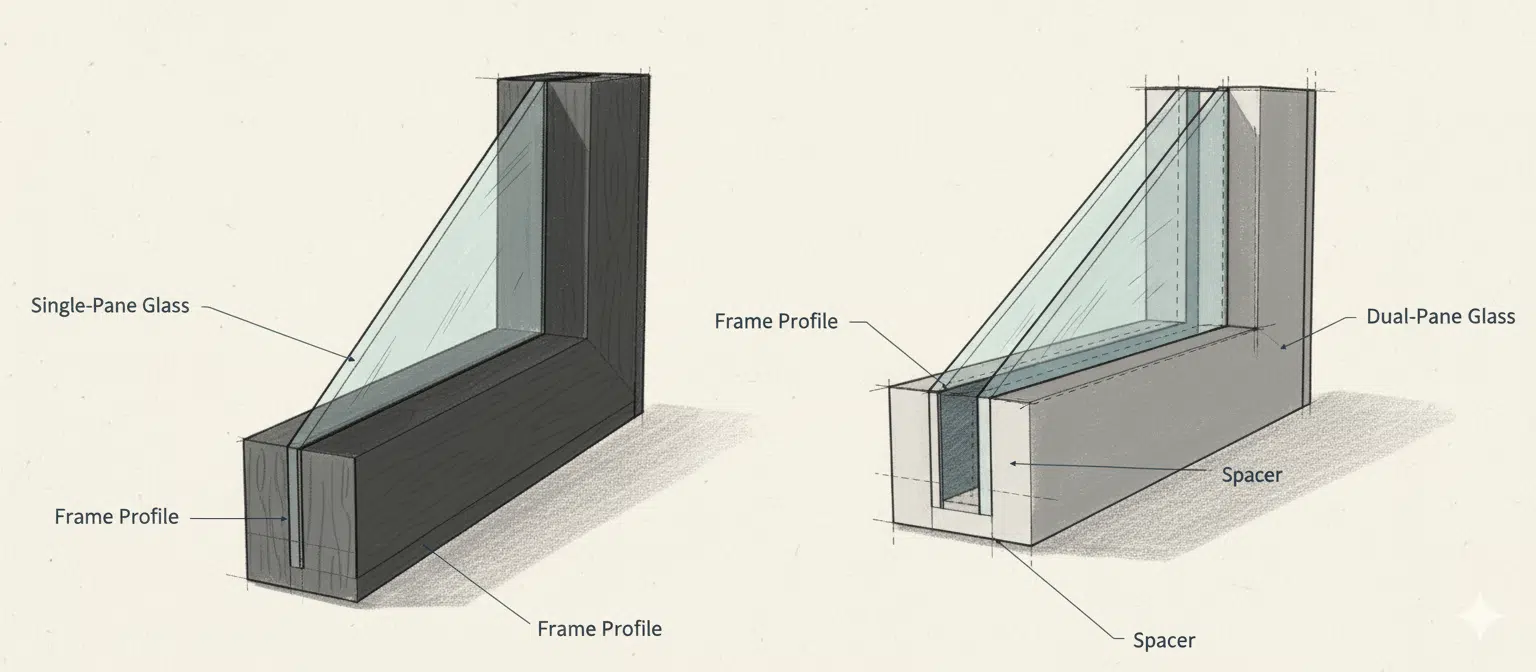
Sound is pressure waves. Glass is rigid and efficient at transmitting them — a single-pane window vibrates at the frequency of the external sound source and re-radiates it inside the room. Three physical mechanisms reduce sound transmission through a glazing assembly: mass (heavier glass vibrates less readily and absorbs more wave energy), an air gap (a sealed cavity between two panes dramatically reduces transmission by providing an impedance discontinuity the sound wave must cross twice), and damping (a PVB interlayer in laminated glass absorbs vibration energy before it can be re-radiated on the inside face).
Traffic and aircraft noise is predominantly low frequency — typically 50–500 Hz. Low frequency is the hardest range to block because long wavelengths are not significantly impeded by small barriers. It’s why simply adding more glass or a thicker single pane doesn’t achieve much. The mechanism that works is the air gap combined with damping — an acoustic IGU with a laminated inner pane — not just weight alone.
The three acoustic upgrade options
Laminated glass as a single-pane upgrade. A 6.38mm laminated pane (two 3mm sheets bonded with a PVB interlayer) outperforms standard 6mm toughened glass, particularly in the low-frequency range where PVB damping is most effective. This is the right upgrade when full frame replacement isn’t feasible and only the glass is being changed. Approximate Rw: 33–35 dB compared to 27–29 dB for standard 3mm float.
Standard double glazed IGU (4-12-4). Good performance across the mid-frequency range where most road noise sits. The sealed 12mm cavity provides significant attenuation. Has a resonance vulnerability at a specific frequency (determined by the two pane masses) where both panes vibrate together and the cavity provides little benefit. Approximate Rw: 32–36 dB.
Acoustic double glazed IGU (asymmetric panes + laminated inner). Uses panes of different thickness — typically a 6mm toughened outer pane and a 10.38mm laminated inner pane (or equivalent asymmetric combination). The different thicknesses mean each pane resonates at a different frequency, eliminating the resonance weakness of a symmetric IGU. The laminated inner pane adds PVB damping across the full frequency range. This is the correct specification for any property fronting an arterial road, adjacent to a railway corridor, or under a flight path. Approximate Rw: 38–45 dB depending on the configuration.
Performance comparison
| Glass specification | Typical Rw (dB) | Perceived noise reduction | Best for |
|---|---|---|---|
| 3mm single float | 27–29 | Baseline | Low-noise environments |
| 6mm single toughened | 29–31 | Slight | Minimal upgrade |
| 6.38mm laminated single | 33–35 | ~30% perceived reduction | Pocket replacement where frames are staying |
| Standard IGU (4-12-4) | 32–36 | ~30–40% perceived reduction | General thermal + acoustic improvement |
| Acoustic IGU (asymmetric + laminated) | 38–45 | ~50–60% perceived reduction | Road noise, rail corridors, flight paths |
Why the frame matters as much as the glass
The best-specified acoustic glass in a poorly sealed frame will deliver well below its laboratory Rw rating. Sound flanks through any gap — a perished rubber gasket, a worn brush pile seal on a sliding window, a gap where silicone has pulled away from the wall at the frame junction. The laboratory test is conducted with the window assembly sealed into a rigid wall with no gaps. On site, the seal quality of the installation determines how much of that rated performance is actually delivered.
Awning and casement windows seal by compression against a continuous perimeter gasket — no inherent gap. Their installed acoustic performance is consistently closer to their rated Rw than sliding windows, which have an inherent small gap in the brush pile seal. If specifying acoustic glass in a sliding window or door, ensure the frame brush pile seals are in good condition — or replace them at the same time as the glass. For the highest acoustic requirement, specify awning or casement window types alongside the acoustic IGU.
The weak point of standard double glazing for aircraft noise
People who have installed standard double glazing near an airport sometimes report disappointment — the improvement was less than expected for aircraft noise specifically. This is the resonance issue. A standard 4-12-4 IGU has two identical 4mm panes that resonate at the same frequency. At that resonance frequency — which often falls within the range of aircraft engine noise — the sealed cavity provides almost no acoustic benefit and the two panes essentially act as a single, slightly heavier panel. An acoustic IGU with a laminated inner pane of different thickness eliminates this resonance peak. If aircraft noise is the primary concern, specify the acoustic configuration, not a standard IGU.
Realistic expectations
No window eliminates external noise entirely. A correctly specified acoustic double glazed window in a well-sealed aluminium frame will reduce perceived noise by approximately 50–60% — which is a substantial change. But in an absolute sense, you’ll still be aware the street exists. A garbage truck at 5am will still be audible. The goal is making the noise liveable — comfortable sleep, comfortable conversation in the room, the ability to concentrate — not eliminating it entirely.
FAQs
We’ll specify the right acoustic glass for your situation. Free quote across Greater Sydney.
Call 1300 854 726